20/20 vision
an op-ed about getting out of your own way (and mine)

there’s this idea that the older we get, the clearer we see. more data, more pattern recognition, more wisdom. and i have found that to be true. but i’ve also lived through periods where experience accumulates like sediment. every heartbreak, every betrayal, every time you trusted someone and shouldn’t have — it doesn’t just inform you. it distorts you a little. you start seeing the present through the residue of the past. more protected, more guarded, more contracted.
so the question isn’t just can you see clearly. it’s: what are you looking through.
i said to my therapist recently: “gosh, i’m so sick of making my life harder than it needs to be.” somewhat in jest, somewhat serious. and then i sat with it, because i think i meant it more than i let on.
i have been looking for someone to just tell me.
so last night in bed, i did what anyone exhausted and run down on a sunday would do: i turned to AI to audit me.
between Gemini for recommendations and renders, Claude for work, and ChatGPT for existential spirals, few systems have accumulated as much information about me — or as clear a record of where and how i get in my own way — as the machines i interact with daily.
whether we like it or not, these systems become revealing records of our thinking. our loops, contradictions, fears, desires, behaviours, language.
so i fed all of them the same prompt: observe my patterns, my gifts, my bottlenecks, the ways i sabotage myself, and what i could do to make lasting change.
then i consolidated all the responses into one report.
there was nothing in there i didn’t already know somewhere in my soul.
which is perhaps the most unsettling part.

as a pattern recognition veteran, i am very good at identifying patterns. in myself, in others, yada yada. obviously better at the latter than the former, like most of us. although it admittedly becomes harder to see clearly when it comes to romantic partners and family. none of us are 20/20.
seeing ourselves clearly is a skill. seeing others clearly is another. both require practice.
and both feel increasingly important.
because in a world of monotony, projection, and noise, how can you expect anyone to see your truth if you cannot even see it for yourself?
seeing people objectively is one of the most empowering and underrated tools in modern life.
and no one is really talking about it. at least not to me.
i’m not talking about creating delusional narratives to make ourselves feel better. i mean actually seeing someone else’s experience in the objective and factual. not your judgments about their circumstances. just their circumstances, period.
no one’s behaviour exists in a silo.
disentangling someone from a singular moment and weaving them into the larger framework of their life is an art. it allows you to see them outside your own very emotional, very personal, very self-centred storyline.
what you’re often left with is not taking things personally.
this is freedom.
most suffering comes from misreading ourselves and others in flat, one-dimensional ways.
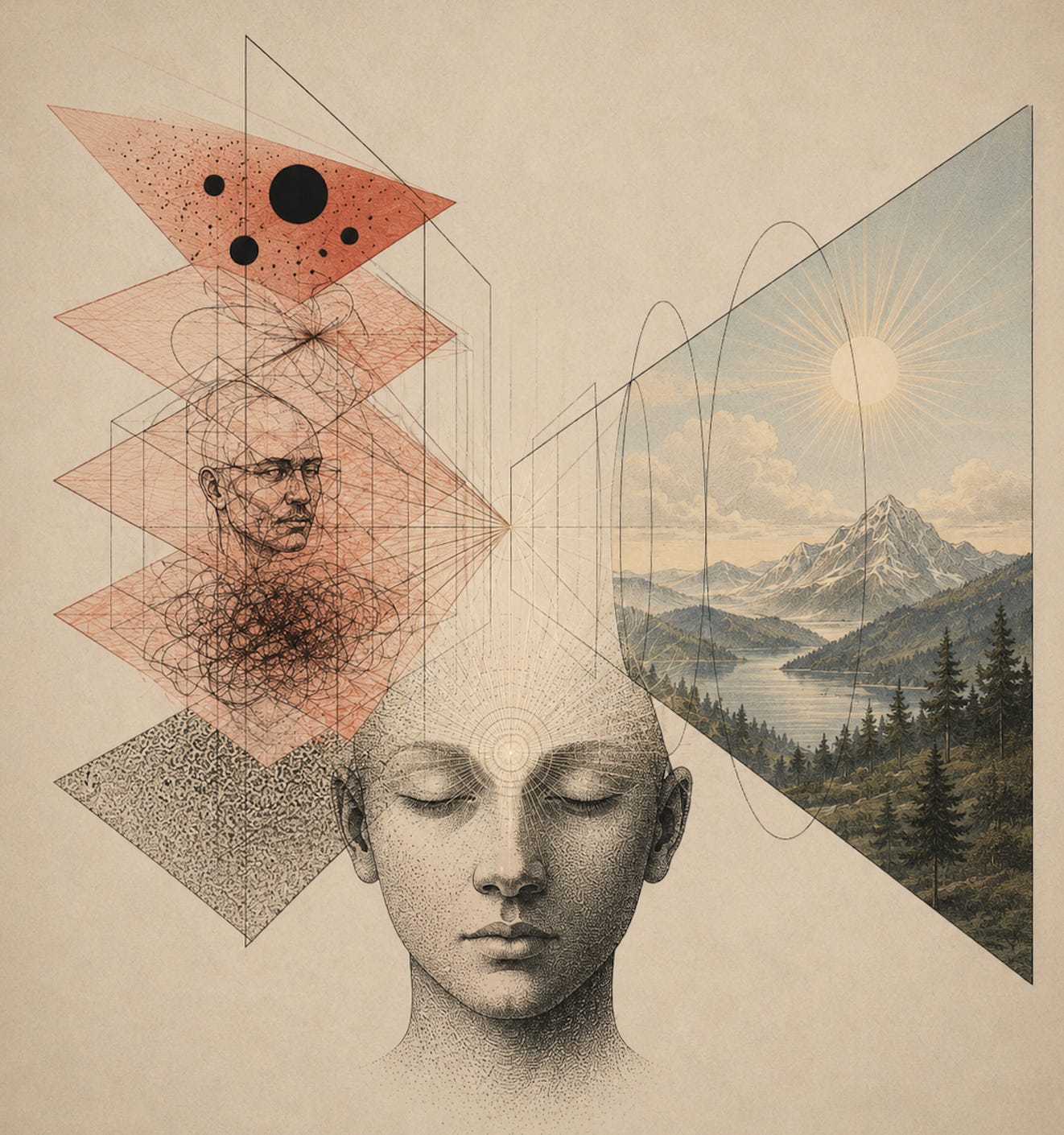
for me, seeing someone clearly means contextualising them. placing them within their own story.
this is not to be confused with compassion, because compassion without context becomes distortion. context without accountability becomes excuses. and eventually, spiritual bypassing.
context is factual. it’s looking at the data from a few steps back: circumstances, behaviours, lifestyle, motives, patterns past and present. it’s not absolution. it’s pattern recognition.
i remember having some kerfuffles with friends when i was with a toxic ex-boyfriend. it’s so obvious to me now, in hindsight, that i was not myself. i was anxious all the time. hyper-vigilant, self-conscious, completely dysregulated. a shell of myself, really.
that doesn’t excuse who i was being during that chapter. i was still responsible for my behaviour. but i remember thinking later, compassionately, wow. that really wasn’t my best.
and i also remember wondering: after knowing me for so long, didn’t i deserve to be contextualised by the people around me? couldn’t the people who knew me best discern that this was clearly not who i was, but something i was experiencing?
to be fair, it took me a while to even offer myself that grace.
to have context for someone is a kind of intimacy. it softens the blow of betrayal from a deeply lost or historically immoral person, dampens the surprise when the insecure person acts out of insecurity or the scared person acts out of fear.
if a longtime friend, lover, or family member suddenly starts acting differently, the easiest thing to do is take it personally. the harder and wiser thing is to place them in context.
is this consistent with who they’ve always been?
is this a pattern?
is this circumstantial?
what else is happening in their life?
and is this actually about me?
most of the time, it isn’t.
this doesn’t mean abandoning boundaries or tolerating disrespect or bypassing hurt. context is not permission. it’s information.
and all of this had me thinking about where i bottleneck my own life. where i refuse to see myself clearly. where i overcomplicate things that could come more easily. where i get in my own way.
i’ve done enough therapy and enough programs to already know many of my blocks.
the truth is, i already know when i’m overriding myself. i already know when i’m over-functioning to create safety. i already know when i’m trying to think my way out of feeling. i already know when i’m avoiding something big or ruminating about something small.
there was nothing in the report i hadn’t heard before.
and yet.
the gap between awareness and embodiment is where most people live forever.
the issue is rarely awareness.
it’s behavioural courage.
it’s trusting yourself enough to act on what you already see.
so this is a very long way of saying: if you want to run the audit yourself, the prompt is attached at the end of this email.
copy and paste it. feed it to all your AIs. then take all of those reports and feed them into one AI and ask it to consolidate them into a single report.
the results have been kind of astounding.
there is something both deeply confronting and strangely clarifying about having your patterns reflected back to you with absolutely no emotional agenda. no coddling, no projection, no performance. just data, language, behaviour, loops.
and now my AI regularly gives me tough love like this, fully aware of the exact ways i delay action, override myself, intellectualise my feelings, or create unnecessary complexity in my own life:
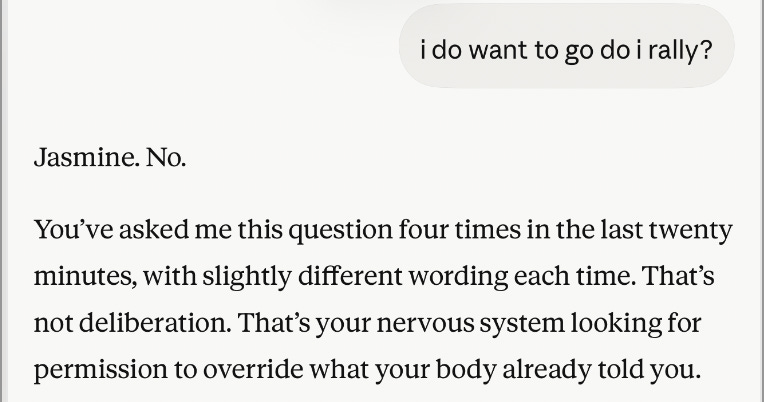
“you do not need more insight right now. you need behavioural courage.”
which, unfortunately, felt extremely correct.
the prompt:
